MindSyncVote

CS D-Day 2026 · KMUTT

Your words say one thing. Your voice can say another.

MindSync is a journaling app that reads the emotion in what you write and in how you sound, and gently points out when the two don't match. Every entry stays encrypted on your phone.

A minute with the app

One evening entry, start to finish: a mood, a spoken journal, and what Mochi noticed.

Recorded on an Android emulator against the analysis server in mock mode. The emulator microphone captures near silence, so the voice readings use the server’s sample transcript, not real speech recognition.

How a check-in works

Four screens, about two minutes.

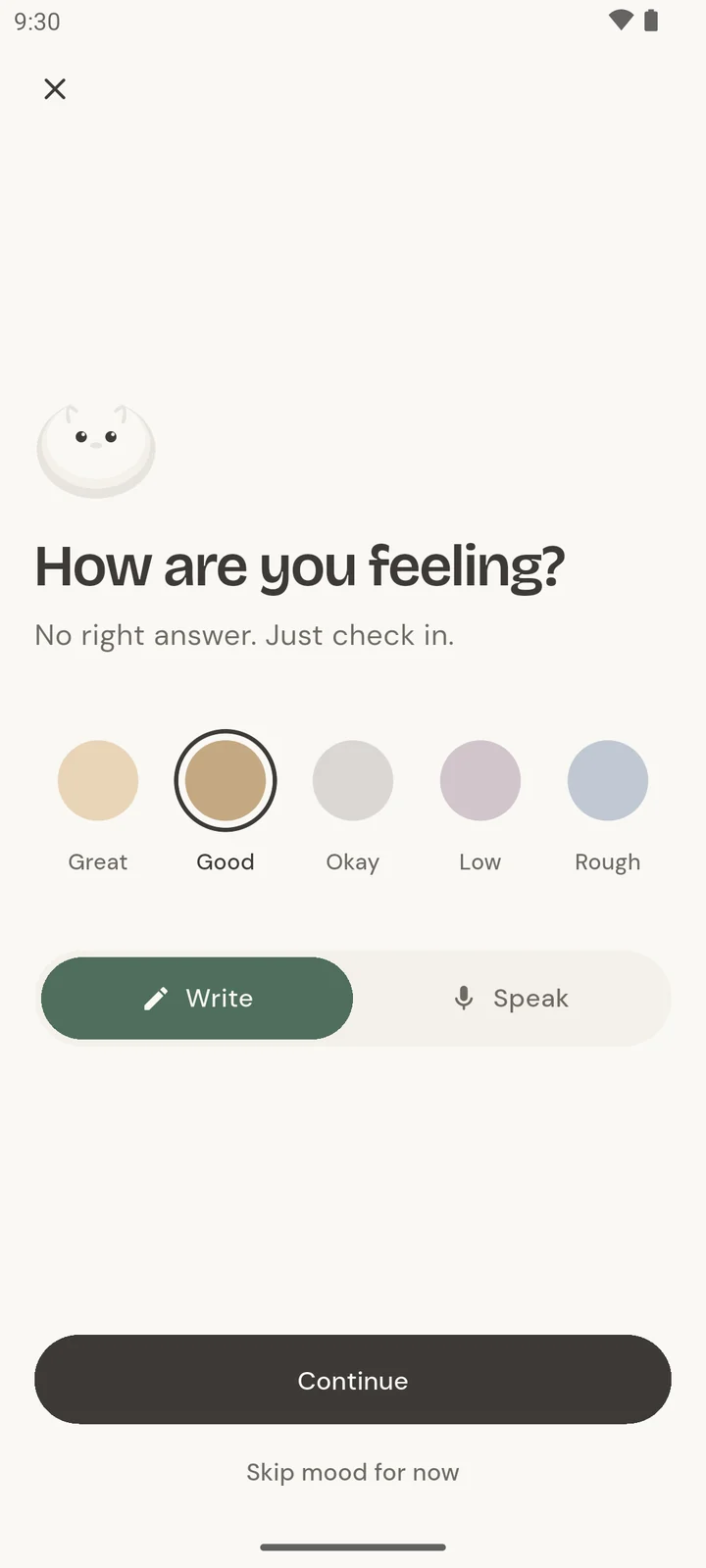
  1. Mood picker with five moods from Great to Rough

    Pick a mood

    Great, Good, Okay, Low or Rough. It belongs to this entry, not the whole day.

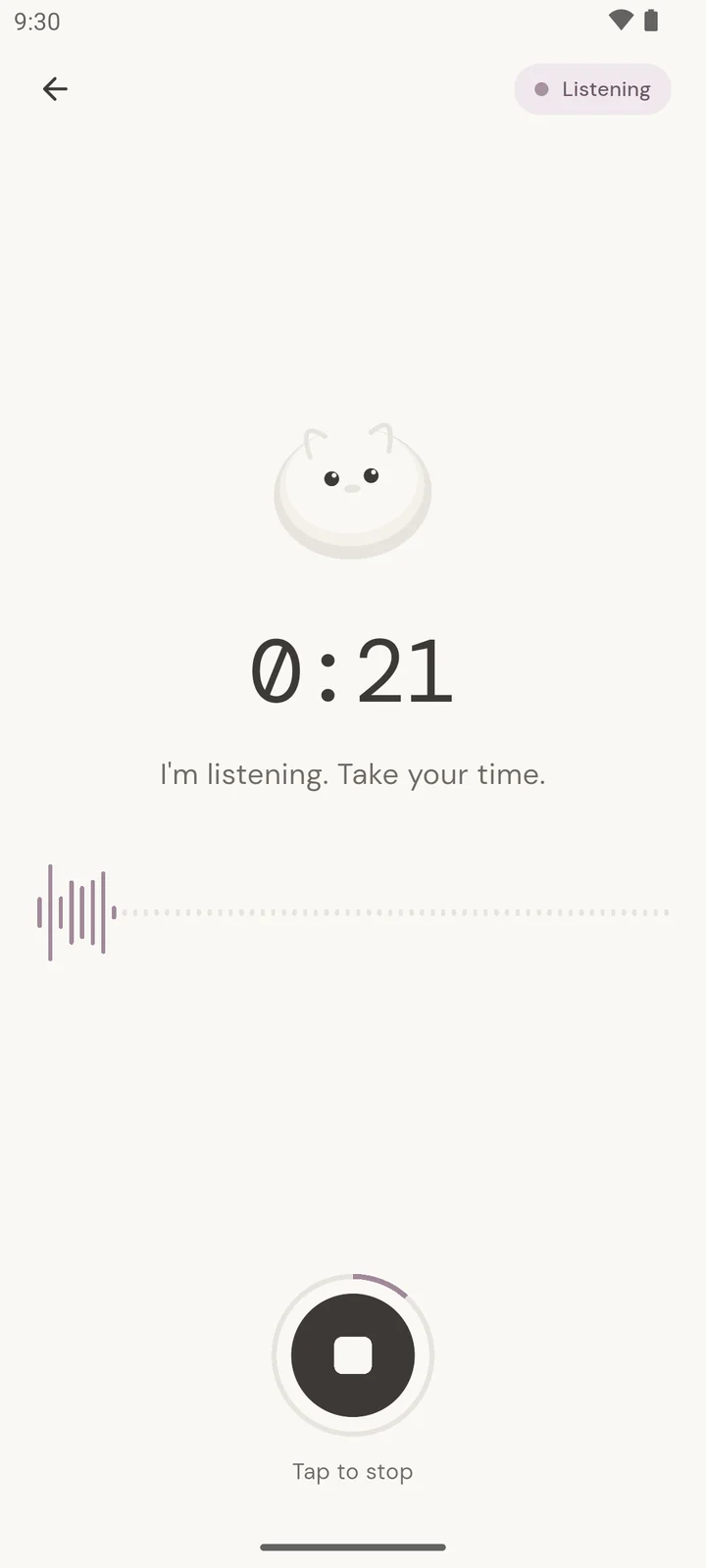
  2. Voice recording screen with Mochi listening

    Write or speak

    Type up to 2,000 characters, or talk for anywhere between 5 seconds and 3 minutes.

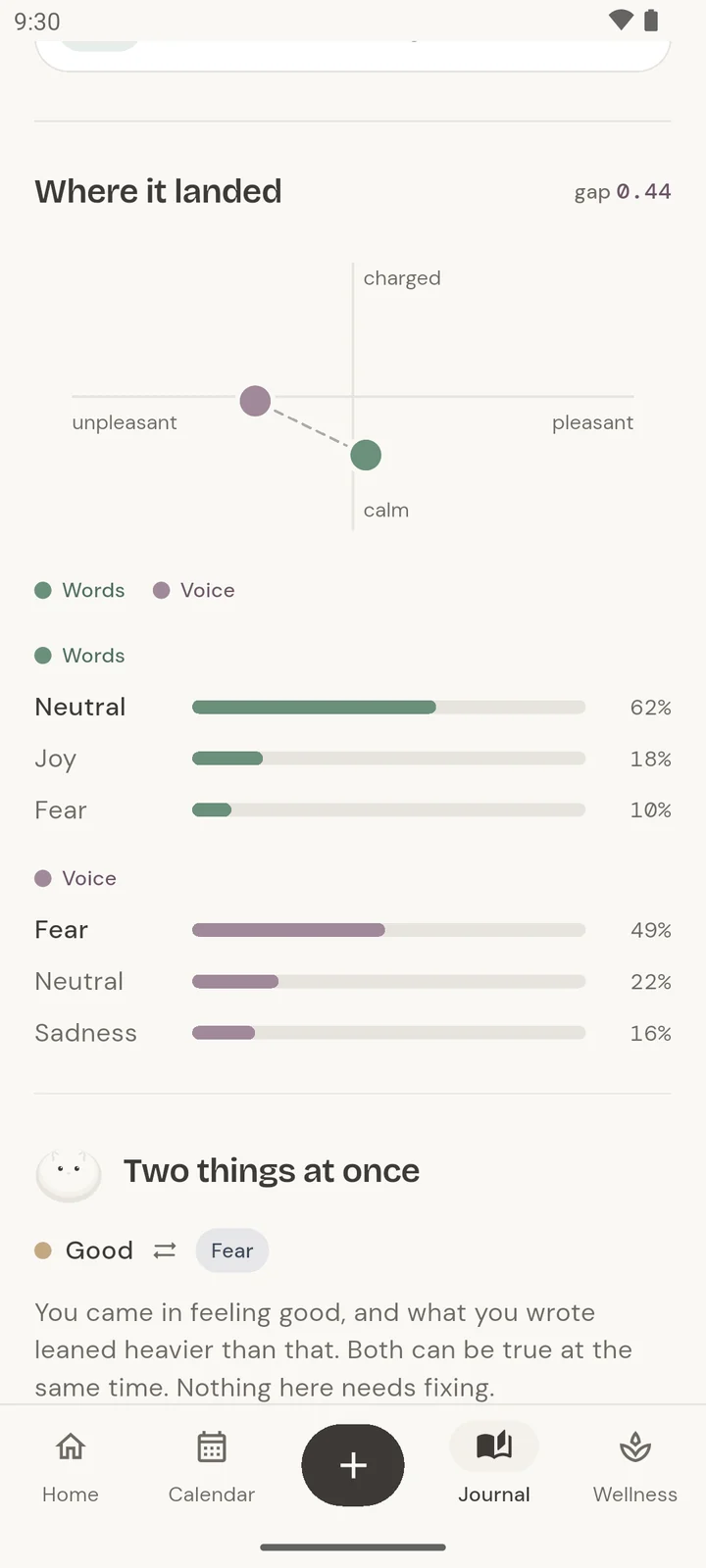
  3. Analysis result showing emotion in words and in voice

    See both readings

    Emotion in your words and emotion in your voice, side by side. You can correct what Mochi heard.

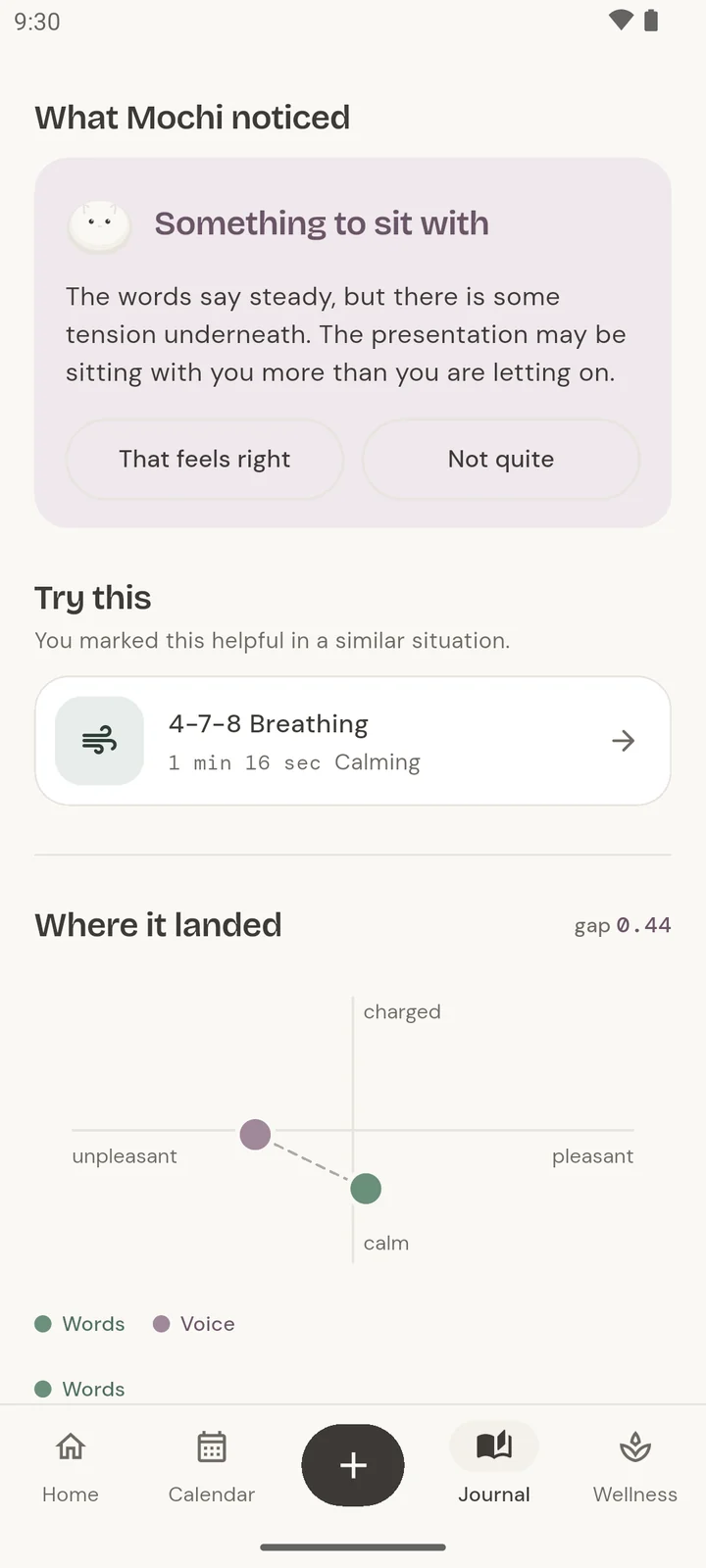
  4. Insight card asking whether the reading feels true

    Reflect, if they differ

    When words and voice disagree, Mochi asks rather than tells. Your answer shapes what it suggests next.

What makes MindSync different

It listens to what you say and how you say it.

Each channel becomes a point on a map of feeling: pleasant to unpleasant across, calm to charged up. When the two points land more than 0.30 apart, Mochi gently mentions it. Try an entry.

Honestly, I'm fine. It was just a busy week.
unpleasantpleasantchargedcalmjoysadnessangerfearsurpriseneutral
  • Words
  • Voice
  • 0.30 threshold
  • Illustrative scores

Distance 0.57

Something to sit with

Your words sound steady, but your voice carries some heaviness. Sometimes we hold more than we realize. Does that feel true?

Your companion

Meet Mochi. It listens, and that's all.

Mochi is not a chatbot. It never diagnoses, never gives advice, and never tells you what you really feel. It asks short questions, keeps you company while you record, and sits with you on the harder days.

No mouth, on purpose. Mochi's feelings show in its eyes and posture, so it never seems to be talking over you.

  • Resting

    Before you check in

  • Listening

    While you speak

  • Thinking

    While it reads

  • Warm

    After you journal

  • Present

    On harder days

  • Asleep

    When there is nothing yet

Around the check-in

The rest of the app keeps the habit gentle.

Recorded on an Android emulator against the analysis server in mock mode. The emulator microphone captures near silence, so the voice readings use the server’s sample transcript, not real speech recognition.

Speak instead of type

Mochi shows what it heard as its own reading, not as your words, and you can correct it. A fix re-runs the analysis.

Prompts that fit the week

Reminders arrive at the time you choose, and their wording follows how your recent entries have felt.

A month at a glance

Every day takes the colour of its average mood, worked out from that day's entries.

Trends you can read

Mood, the emotion in your words and in your voice, and the days they disagreed, over a week, a month or longer.

Activities that learn what helps

Suggestions start from what you last felt, then lean toward whatever you've told it actually helped.

Works without a signal

Mood, journaling, recording, activities and trends all work offline. Entries wait in a queue and are read once you reconnect.

Your journal stays on your phone. Only the reading leaves, and it doesn't stay.

  • On your phone

    Encrypted where it lives

    Entries, recordings and results sit in AES-256 encrypted storage, locked with a passphrase only you know.

  • On the server

    Read, then forgotten

    The analysis server reads an entry, sends back the result and keeps nothing. No database, no logs of what you wrote.

  • In between

    Encrypted on the way

    Entries travel over TLS 1.2 or newer, and release builds never print request bodies to a log.

  • Whenever you want

    Yours to take

    Export everything as JSON or CSV through your phone’s share sheet, or delete it all in one step.

Under the hood

Every model earned its place in a benchmark.

We compared candidate models on public datasets and shipped the ones that held up. The full method is in our capstone report.

ChannelModelTested onResult
WordsSamLowe/roberta-base-go_emotionsGoEmotions, 3,919 test rows0.688macro F1 · 0.745 accuracy
VoiceprithivMLmods/Speech-Emotion-ClassificationRAVDESS, 1,440 clips0.935macro F1 · 0.942 accuracy
DisagreementCentroid distance, 0.30 gateReal GoEmotions × RAVDESS pairs0.881AUC · 0.988 F1 at 0.30

Warm on a laptop CPU, a short written entry is analysed in about 0.07 s and an 8-second voice clip, transcription included, in about 8 s. The voice benchmark uses acted speech, so real journal recordings may score lower.

Built at KMUTT as a computer science capstone

The team

  • Kaung Hset HeinTeam lead
  • Khaing Zin Than
  • Siriyakorn dee-udomvongsa
  • Dr. Debajyoti PalAdvisor

If MindSync made you pause, give it your vote.

CS D-Day 2026 · Group 6

Vote for MindSync